The Company strives to maintain a high standard of corporate governance practices and procedures to safeguard the interests of its Shareholders. The corporate governance level is constantly improved and enhanced by establishing an internal control and risk management system and enhancing accountability and transparency.
CORPORATE GOVERNANCE PRACTICE
The Board has adopted various policies to ensure compliance with the Corporate Governance Code as set out in Appendix C1 to the Listing Rules (including the mandatory disclosure requirements in Part 1 and the principles, code provisions and recommended best practices for good corporate governance in Part 2 (the “Code Provision”)), as well as the relevant requirements of the Environmental, Social and Governance Reporting Guide as set out in Appendix C2 to the Listing Rules (collectively, the “Code”).
The Board considers that the Company has complied with all the applicable Code Provisions during the year with the exception of the deviation as disclosed in this report. In the future, the Company will also adopt more Recommended Best Practices as set out in the Code according to actual needs, so as to further enhance the level of corporate governance.
CORPORATE CULTURE AND VALUES
In order to ensure that a healthy corporate culture is cultivated and that the Company’s purpose, values and strategies are aligned with its culture, the Board will strictly enforce internal policies and internal risk assessments such as the Anti-Corruption Policy (《反貪腐政策》) and the Whistleblowing Policy (《舉報政策》). Apart from organising regular trainings for our employees, the Company will make appropriate adjustments to various policies from time to time in order to regulate and promote a legal, ethical and responsible corporate culture. The Company also places great emphasis on transparency and accountability, and will regularly communicate with relevant stakeholders with respect to their business performance. On the Board level, the Company requires all Directors to act with integrity, to lead by example, to be committed to promoting the said corporate culture, and to consistently reinforce the values of acting lawfully, ethically and responsibly.
The Company believes that fostering a legal, ethical, and responsible corporate culture is critical to the Company’s long-term sustainability goals, which in turn will enable the Company to nurture and attract talented individuals, build a healthy corporate culture, and maintain the Company’s ability to grow sustainably and profitably.
DIRECTORS’ AND EMPLOYEES’ SECURITIES TRANSACTIONS
The Company has adopted a model code of conduct no less than that required by the Model Code as set out in Appendix C3 to the Listing Rules as its code of conduct of Directors conducting securities transactions. All Directors have confirmed, following specific inquiry of all Directors by the Company, that they have complied with the required standards set out in the above Model Code in relation to such transactions during the year.
The Company has also formulated written guidelines regarding the securities transactions by the employees of the Company who may be exposed to insider information. The requirements of the written guidelines are no less exacting than those set out in the Model Code. The Company recorded no non-compliance events during the year.
THE BOARD OF DIRECTORS
The Board is responsible for formulating the overall development strategy, operation and financial reporting of the Company, internal control and risk management, major acquisitions, substantial connected transactions, annual and interim results, proposed interim and final dividends, proposed appointment or re-election of Directors, appointment of auditor, share issue and repurchase and other operational and financial matters relating to the Company. On 1 October 2019, the Board approved and adopted the “Management Measures for the Board of Directors” (《董事會管理辦法》) to regulate the operation of the Board.
Composition of the Board
As of 31 December 2025, the Board consisted of eight members, namely three executive Directors (Mr. Liu Guanghui, (chairman of the Board, resigned on 26 February 2026), Mr. Zhou Jun and Mr. Hu Jun), one non-executive Director (Ms. Zhong Yan) and four independent non-executive Directors (Mr. Chan Kay-cheung, Ms. Yau Lai Man, Hon. Rock Chen Chung-nin and Mr. Tang Yi Hoi). The Company forms its Board based on the characteristics and uniqueness of its operations to ensure that each Director possesses the required industrial experience and managerial expertise. The personal biographies of the Directors are set out in pages 58 to 63 of the annual report.
The Directors clearly understand that they should fulfill their duties diligently in the best interests of the Company and its Shareholders. The Company has signed appointment letters with all Directors for a fixed term of three years unless terminated by either party giving to the other not less than 1 month’s prior notice in writing, but the Directors are subject to retirement by rotation and re-election according to the Articles of Association.
Mr. Hu Jun (appointed as an executive Director on 14 November 2025) has, in accordance with the Listing Rule 3.09D, obtained legal advice from a law firm qualified to provide opinions on Hong Kong law on 12 November 2025, to understand all the provisions applicable to him as a director of a listed issuer under the Listing Rules, as well as the potential consequences of making false declarations or providing false information to the Hong Kong Stock Exchange.
The Board delegated its authorities and obligations in the management of daily operations, business strategies and the Group’s business to the executive Directors and senior management, and delegated certain specific responsibilities to the committees under the Board.
Relationship between Board Members
To the best knowledge of the Company, there is no financial, business, family or other material/relevant relationship between the Board members.
Responsibilities of the Chairman and Managing Director
Pursuant to Code Provision C.2.1, the roles of chairman and chief executive should be separate and should not be performed by the same individual. It is the consistent policy of the Company to appoint different individuals to act as chairman of the Board and managing Director to ensure the accountability and independence of the policymaking process of the Company. The chairman of the Board is responsible for leading the Board. The chairman of the Board should ensure that the Board works effectively and discharges its responsibilities, and be responsible for building the management of the Company, organising the formulation of the development strategies, etc. The managing Director is responsible for managing the daily business operations of the Group, implementing the development strategies formulated by the Board, expediting the development of high-end integrated logistics business, driving the development of the passenger transportation business, etc. and strengthening the internal management.
Mr. Liu Guanghui (“Mr. Liu”, chairman of the Board), an executive Director, has resigned as the executive Director and chairman of the Board as well as chairman of the Nomination Committee (the “Nomination Committee”), member of the remuneration committee and the executive committee of the Company on 26 February 2026. Following the resignation of Mr. Liu, the Company has not yet appointed a new chairman of the Board, and the position of chairman of the Board is vacant. The Board will make its best endeavours to identify appropriate person for appointment as the chairman of the Board, as soon as practicable and within three months from the date of Mr. Liu’s resignation.
According to Code Provision C.2.7, the chairman of the Board has held a meeting with the non-executive Directors, including independent non-executive Directors, without other executive Directors’ presence in the year.
Term of Office of Non-executive Directors
The Company has entered into a letter of appointment with non-executive Director (Ms. Zhong Yan) for a fixed term of three years (from 1 April 2023 to 31 March 2026), subject to retirement by rotation and re-election in accordance with the Articles of Association.
Independent Non-executive Directors
To ensure the independence of the Board’s decision-making process and to safeguard the interests of Shareholders, the Company has complied with Rules 3.10 and 3.10A of the Listing Rules by appointing at least three individuals with appropriate professional qualifications as independent non-executive Directors, representing not less than one-third of the total number of Directors. The current independent non-executive Directors are experienced professionals with diverse backgrounds covering finance, accounting, passenger transportation and logistics services. One of the independent non-executive Directors possesses the appropriate accounting or related financial management expertise as required under Rule 3.10(2) of the Listing Rules. The Company ensures that they are provided with adequate access to the Company’s information and are able to engage in full discussion and express independent opinions on matters of the Company.
In accordance with the Code Provisions, a tenure of over nine years is regarded as an important factor in assessing the independence of an independent non-executive Director. Mr. Chan Kay-cheung (“Mr. Chan”) and Ms. Yau Lai Man (“Ms. Yau”), both being independent non-executive Directors, have each served for more than nine years. During their tenure, they have continued to provide independent views and advice and have made contributions to the Company in relation to its business, operations, future development and strategic direction. Having carefully assessed their character, integrity, competence, experience and past performance, as well as their roles, level of participation and ability to exercise objective judgement, the Board and the Nomination Committee consider that their long service has not impaired their independence of judgement and that they continue to perform their duties objectively and effectively.
Pursuant to Code Provision B.2.3, where an independent non-executive Director has served for more than nine years, his or her further appointment should be subject to a separate resolution to be approved by Shareholders, and the circular accompanying such resolution should set out the reasons why the Board (or the Nomination Committee) considers that the Director remains independent and should be re-elected, including the factors considered and the relevant decision-making process and discussions of the Board (or the Nomination Committee). Mr. Chan retired by rotation at the annual general meeting held on 21 June 2023 and, being eligible, offered himself for re-election, and was re-appointed by a separate resolution of the Shareholders at that meeting. Ms. Yau retired by rotation at the annual general meeting held on 22 May 2025 and, being eligible, offered herself for re-election, and was re-appointed by a separate resolution of the Shareholders at that meeting.
To align with the requirements on the tenure of independent non-executive Directors introduced under the “Update No.148 on Amendments to the Main Board Listing Rules” by the Hong Kong Stock Exchange, the Company has formulated corresponding transitional arrangements to progressively optimise the structure of the Board. Under such arrangements, at the first annual general meeting held after 1 July 2028, more than half of the independent non-executive Directors will have served for less than nine years; and at the first annual general meeting held after 1 July 2031, there will be no independent non-executive Director who has served for nine years or more. During the transitional period, where the Company decides to re-elect any independent non-executive Director who has served for more than nine years, additional disclosure will be made regarding the Nomination Committee’s assessment process, with particular focus on how the Director’s ability to continue to make objective contributions has been evaluated, as well as the Board’s consideration of the relevant recommendation. The Company understands that the assessment should focus on substantive contribution rather than mere formal compliance with independence guidelines.
In accordance with Article 88(i) of the Articles of Association, Mr. Chan will retire by rotation at the forthcoming annual general meeting and, being eligible, will offer himself for re-election. His re-appointment will be proposed to Shareholders by way of a separate resolution. As such re-election takes place within the six-year transitional period under the above Listing Rule amendments, the Company will comply with the relevant disclosure requirements by providing detailed explanations of the Nomination Committee’s and the Board’s assessment process and considerations in relation to Mr. Chan’s re-appointment, with emphasis placed on his ability to continue to make objective contributions rather than merely satisfying formal independence criteria.
In addition, in accordance with the amended requirements on the cap on concurrent directorships, and in order to ensure that independent non-executive Directors are able to devote sufficient time and attention to the discharge of their duties, with effect from 1 July 2028, each independent non-executive Director may not concurrently hold directorships in more than six Hong Kong listed issuers. A three-year transitional period applies, whereby any person who, on or before 30 June 2028, holds directorships in seven or more listed issuers must, at the first annual general meeting of any issuer at which he or she serves as a Director held on or after 1 July 2028, reduce the number of such directorships to comply with the above cap. The Company confirms that all existing independent non-executive Directors currently comply with this requirement and that no adjustment to the composition of the Board is required. All independent non-executive Directors are able to remain fully focused on the discharge of their duties to the Company and continue to provide adequate support and contributions to the effective operation of the Board and its strategic decision-making.
The Company has received from each of the current independent non-executive Directors an annual confirmation of his/her independence. The Company considers that all the independent non-executive Directors have maintained their respective independence in accordance with Rule 3.13 of the Listing Rules.
Board Diversity Policy
In addition, in accordance with the amended requirements on the cap on concurrent directorships, and in order to ensure that independent non-executive Directors are able to devote sufficient time and attention to the discharge of their duties, with effect from 1 July 2028, each independent non-executive Director may not concurrently hold directorships in more than six Hong Kong listed issuers. A three-year transitional period applies, whereby any person who, on or before 30 June 2028, holds directorships in seven or more listed issuers must, at the first annual general meeting of any issuer at which he or she serves as a Director held on or after 1 July 2028, reduce the number of such directorships to comply with the above cap. The Company confirms that all existing independent non-executive Directors currently comply with this requirement and that no adjustment to the composition of the Board is required. All independent non-executive Directors are able to remain fully focused on the discharge of their duties to the Company and continue to provide adequate support and contributions to the effective operation of the Board and its strategic decision-making.
The Company has received from each of the current independent non-executive Directors an annual confirmation of his/her independence. The Company considers that all the independent non-executive Directors have maintained their respective independence in accordance with Rule 3.13 of the Listing Rules.
Directors’ Responsibilities for Financial Statements
During each financial period, the Directors are responsible for the preparation of the financial statements that give a true and fair view of the state of affairs of the Group and of its results and cash flows during the relevant period. In preparing the financial statements for the year, the Directors selected and applied consistently appropriate accounting policies, made careful and reasonable judgments and estimates, and prepared the financial statements on a going concern basis. The Directors are responsible for the filing of appropriate accounting records that reasonably and accurately disclose the financial position of the Company at any time. The Board is not aware so far of any significant uncertain events or circumstances which would affect the business of the Company or its ability to continue its operation. The responsibilities of the Company’s external auditor are set out in the Independent Auditor’s Report on pages 87 to 92 of the annual report.
Board Meeting Procedures
The Board held regular meetings during the year. The company secretary of the Company (the “Company Secretary”) assists the chairman of the Board in establishing the meeting agenda, and each Director/committee member may request the inclusion of items in the agenda. The date and agenda of the Board meeting will be available to the Directors at least 14 days in advance and related documents will be available to the Directors at least 7 days in advance to enable each Director to fully understand the matters to be discussed and make an informed opinion. Draft and final versions of the minutes of Board meetings and Board committee meetings prepared in sufficient details by the secretary of the meetings, were circulated to the Directors for their comment and record respectively. Originals of such minutes, being kept by the Company Secretary, are open for inspection at any reasonable time on reasonable notice by any Director. Each Director has the right to seek independent professional advice in furtherance of his/her duties at the expense of the Company. No Director has requested to seek professional advice as mentioned above during the year.
If a Director has a conflict of interest in a matter to be considered at the meetings of the Board and the committee which the Board has determined to be material, such Director may express his/her recommendations but shall not be counted in the quorum and shall abstain from voting on the relevant resolution.
All Directors have unrestricted access to the Company Secretary who is responsible for ensuring that the Board/ committee procedures are complied with, and for advising the Board/committee(s) on compliance matters.
Succession Planning for Directors and Senior Management
The Company is committed to ensuring leadership continuity of the Board and senior management in support of its long-term business development and corporate governance. The Board approved and adopted the Succession Plan with effect from 1 November 2025. The Succession Plan provides a clear framework to assist the Nomination Committee and the Board in identifying and developing suitable successors in a timely manner and ensuring smooth transition of duties when necessary. The Nomination Committee is responsible for formulating, implementing and reviewing the Succession Plan annually, and recommending any proposed amendments to the Board when appropriate. The Board retains ultimate responsibility for approving the Succession Plan and any subsequent amendments, as well as all appointments of Directors and senior management.
Attendance at Meetings and Time Commitment of Directors
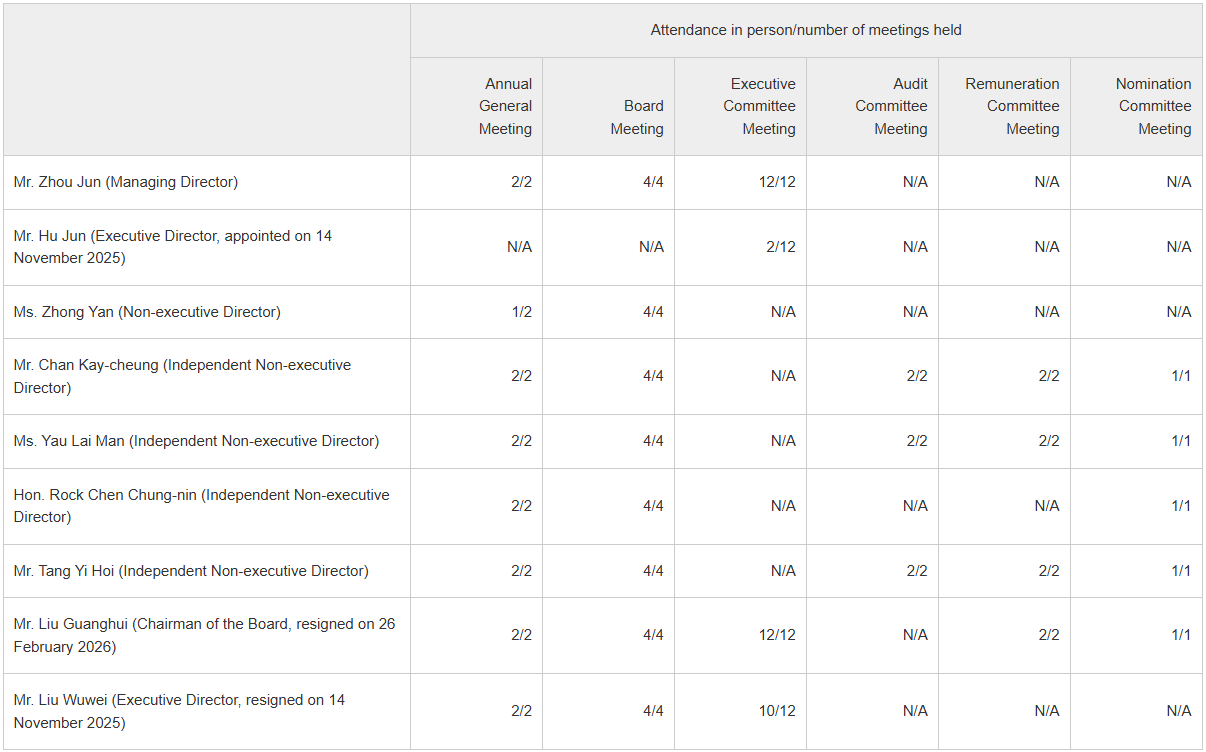
During 2025, the attendance of the Board members at general meetings, the meetings of the Board and respective committees were as follows:
| Attendance in person/number of meetings held | ||||||
| Annual General Meeting |
Board Meeting |
Executive Committee Meeting |
Audit Committee Meeting |
Remuneration Committee Meeting |
Nomination Committee Meeting |
|
| Mr. Zhou Jun (Managing Director) | 2/2 | 4/4 | 12/12 | N/A | N/A | N/A |
| Mr. Hu Jun (Executive Director, appointed on 14 November 2025) | N/A | N/A | 2/12 | N/A | N/A | N/A |
| Ms. Zhong Yan (Non-executive Director) | 1/2 | 4/4 | N/A | N/A | N/A | N/A |
| Mr. Chan Kay-cheung (Independent Non-executive Director) | 2/2 | 4/4 | N/A | 2/2 | 2/2 | 1/1 |
| Ms. Yau Lai Man (Independent Non-executive Director) | 2/2 | 4/4 | N/A | 2/2 | 2/2 | 1/1 |
| Hon. Rock Chen Chung-nin (Independent Non-executive Director) | 2/2 | 4/4 | N/A | N/A | N/A | 1/1 |
| Mr. Tang Yi Hoi (Independent Non-executive Director) | 2/2 | 4/4 | N/A | 2/2 | 2/2 | 1/1 |
| Mr. Liu Guanghui (Chairman of the Board, resigned on 26 February 2026) | 2/2 | 4/4 | 12/12 | N/A | 2/2 | 1/1 |
| Mr. Liu Wuwei (Executive Director, resigned on 14 November 2025) | 2/2 | 4/4 | 10/12 | N/A | N/A | N/A |
Upon reviewing (i) the annual confirmation of the time commitment given by each Director; (ii) the directorships and major commitments of each Director; and (iii) the attendance rate of each Director on the Board and their respective Board committee meetings, the Board is satisfied that all Directors have spent sufficient time in performing their responsibilities during the year.
Directors’ Expertise
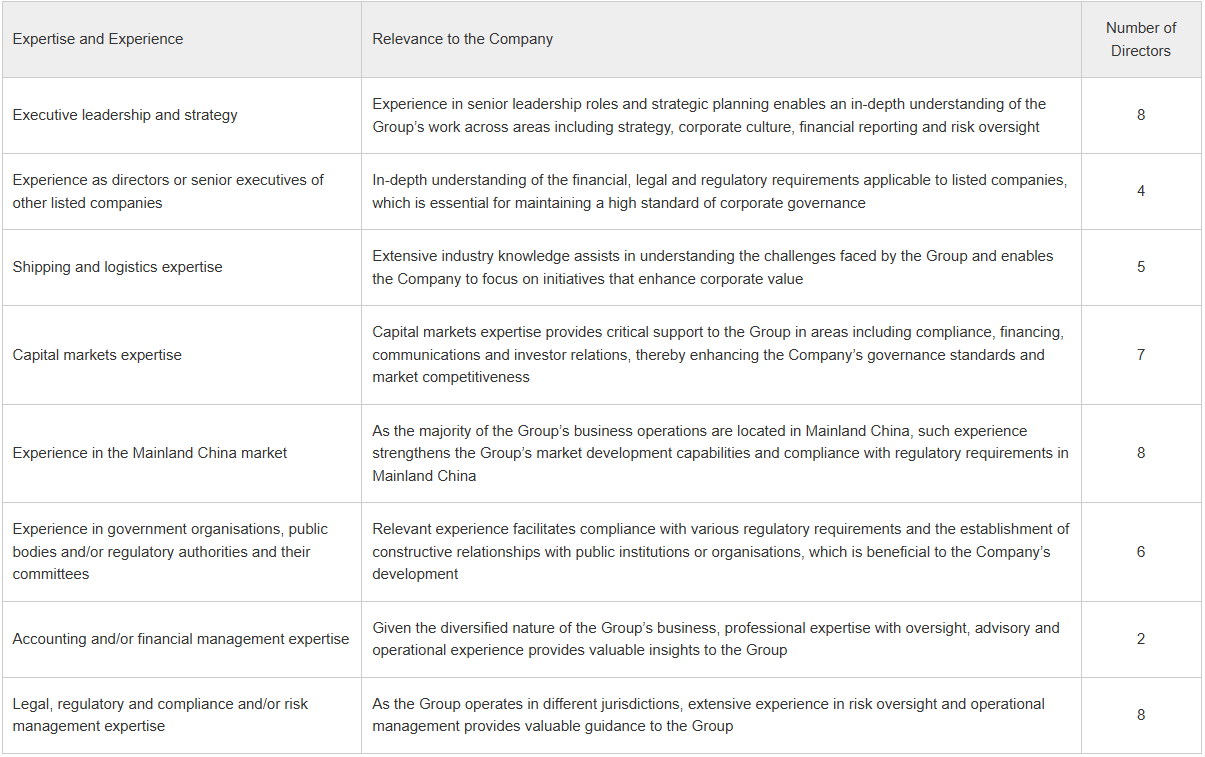
Directors bring different perspectives to the Board based on their respective unique backgrounds and experience.
The following table sets out an overview of the professional expertise and skills of the Directors.
| Expertise and Experience | Relevance to the Company | Number of Directors |
| Executive leadership and strategy | Experience in senior leadership roles and strategic planning enables an in-depth understanding of the Group’s work across areas including strategy, corporate culture, financial reporting and risk oversight | 8 |
| Experience as directors or senior executives of other listed companies | In-depth understanding of the financial, legal and regulatory requirements applicable to listed companies, which is essential for maintaining a high standard of corporate governance | 4 |
| Shipping and logistics expertise | Extensive industry knowledge assists in understanding the challenges faced by the Group and enables the Company to focus on initiatives that enhance corporate value | 5 |
| Capital markets expertise | Capital markets expertise provides critical support to the Group in areas including compliance, financing, communications and investor relations, thereby enhancing the Company’s governance standards and market competitiveness | 7 |
| Experience in the Mainland China market | As the majority of the Group’s business operations are located in Mainland China, such experience strengthens the Group’s market development capabilities and compliance with regulatory requirements in Mainland China | 8 |
| Experience in government organisations, public bodies and/or regulatory authorities and their committees | Relevant experience facilitates compliance with various regulatory requirements and the establishment of constructive relationships with public institutions or organisations, which is beneficial to the Company’s development | 6 |
| Accounting and/or financial management expertise | Given the diversified nature of the Group’s business, professional expertise with oversight, advisory and operational experience provides valuable insights to the Group | 2 |
| Legal, regulatory and compliance and/or risk management expertise | As the Group operates in different jurisdictions, extensive experience in risk oversight and operational management provides valuable guidance to the Group | 8 |
Training for Directors and Company Secretary
All Directors have been given relevant guideline materials regarding the duties and responsibilities of being a Director, the relevant laws and regulations applicable to the Directors, duty of disclosure of interests in shares and business of the Group. Newly appointed Directors are also provided with such induction materials shortly after their appointment and they are required, in accordance with Rule 3.09H of the Listing Rules, to complete the required hours of continuous professional development within 18 months of their appointment, and induction training for Directors is arranged by the Company Secretary.
All Directors have also been updated on the latest development regarding the Listing Rules and other applicable regulatory requirements to ensure compliance with relevant regulations and enhance their awareness of good corporate governance practices. During the year, the Company arranged training for Directors covering, among others, Directors’ duties, fundamental requirements of Board governance, major amendments to the Code Provisions and ESG requirements. The Company also arranged visits to the Group’s subsidiaries for Directors to deepen their understanding of the Group’s business and its latest development.
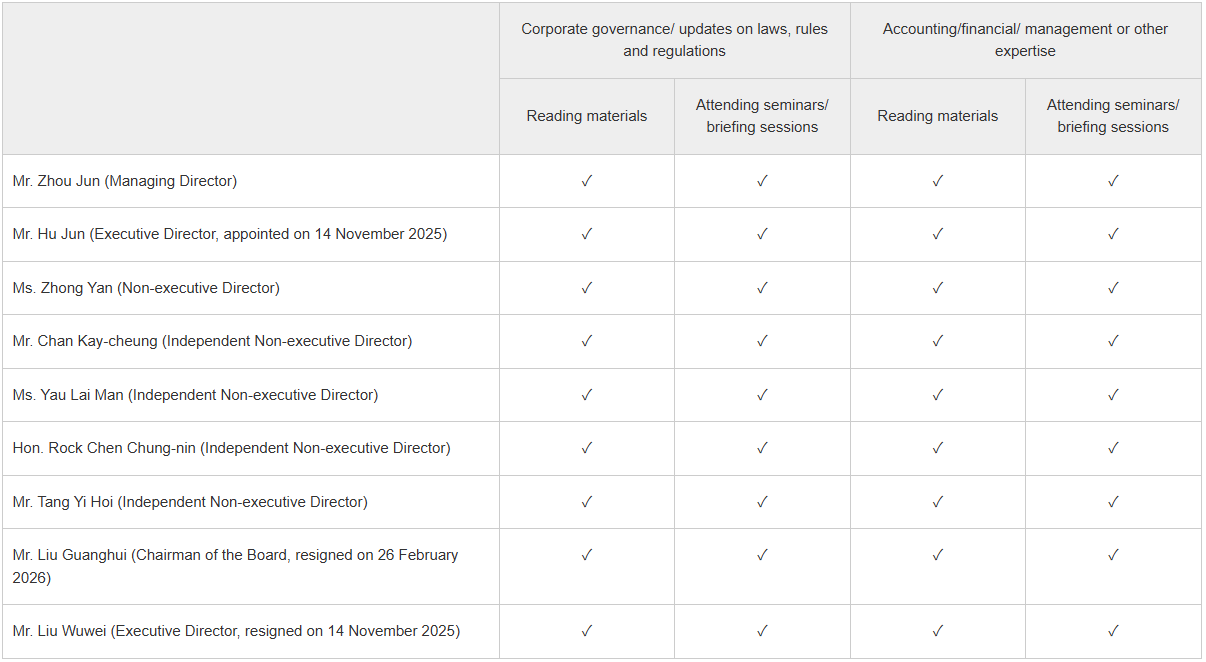
All Directors confirmed that they have complied with the training requirements under the Listing Rules. During the year, all Directors have participated in continuous professional development by reading materials or attending seminars/briefing sessions to develop and refresh their knowledge and skills and provided records of training to the Company. Current Directors have participated in training on the following topics during the year:
| Corporate governance/ updates on laws, rules and regulations | Accounting/financial/ management or other expertise | |||
| Reading materials | Attending seminars/ briefing sessions | Reading materials | Attending seminars/ briefing sessions | |
| Mr. Zhou Jun (Managing Director) | ✓ | ✓ | ✓ | ✓ |
| Mr. Hu Jun (Executive Director, appointed on 14 November 2025) | ✓ | ✓ | ✓ | ✓ |
| Ms. Zhong Yan (Non-executive Director) | ✓ | ✓ | ✓ | ✓ |
| Mr. Chan Kay-cheung (Independent Non-executive Director) | ✓ | ✓ | ✓ | ✓ |
| Ms. Yau Lai Man (Independent Non-executive Director) | ✓ | ✓ | ✓ | ✓ |
| Hon. Rock Chen Chung-nin (Independent Non-executive Director) | ✓ | ✓ | ✓ | ✓ |
| Mr. Tang Yi Hoi (Independent Non-executive Director) | ✓ | ✓ | ✓ | ✓ |
| Mr. Liu Guanghui (Chairman of the Board, resigned on 26 February 2026) | ✓ | ✓ | ✓ | ✓ |
| Mr. Liu Wuwei (Executive Director, resigned on 14 November 2025) | ✓ | ✓ | ✓ | ✓ |
The Company Secretary has confirmed that he/she completed not less than 15 hours of relevant professional training during the financial year in compliance with Rule 3.29 of the Listing Rules.
Mr. Hu Jun was appointed as an executive Director on 14 November 2025. In accordance with Rule 3.09H of the Listing Rules, an initial Director is required to complete not less than 24 hours of continuous professional development as specified under Rule 3.09F within 18 months of appointment. As an initial Director, Mr. Hu Jun will be required to complete not less than 24 hours of continuous professional development within 18 months from the date of his appointment.
Changes in Information of Directors
With effect from 1 August 2025, Mr. Tang Yi Hoi (“Mr. Tang”, the independent non-executive Director of the Company) has been appointed as independent non-executive director of Bamboos Health Care Holdings Limited (stock code: 2293.HK) for a term of two years and renewable automatically for successive terms of one year each thereafter. With effect from 14 August 2025, Mr. Tang has also been appointed as independent non-executive director of JD Logistics, Inc. (stock code: 2618.HK) for a term of three years. With effect from 21 November 2025, Mr. Tang has been appointed as independent non-executive director of Xiamen Jihong Technology Co. Ltd. (stock code: 2603.HK).
With effect from 17 April 2026, Mr. Hu Jun has resigned as the executive Director, the executive deputy general manager and the member of executive committee of the Company.
Save as disclosed in this annual report, pursuant to Rule 13.51B(1) of the Listing Rules, following specific enquiry of all Directors by the Company, all Directors have confirmed that there are no other changes in the information of Directors during 2025 which needs to be disclosed.
Details of changes in the annual remuneration of Directors are set out in the note 38 to the financial statements.
EMPLOYEE GENDER DIVERSITY
The Company is committed to maintaining an appropriate balance between business growth and organisational diversity, and to ensuring that recruitment at all levels, including the Board and senior management, meets diversity standards so that candidates with diverse backgrounds are given fair consideration.
The Company is dedicated to fostering a diverse and inclusive workplace culture and has established and implemented employee diversity policies to ensure that employees are respected and provided with equal opportunities regardless of gender, age, cultural and educational background, race, ethnicity, religion, sexual orientation, gender identity, family status, disability or professional experience. Employment decisions relating to recruitment, training, development, remuneration and promotion are based primarily on qualifications, experience, skills, potential and performance, and any form of discrimination, harassment or prejudice is strictly prohibited. The Company also conducts annual reviews of its workforce diversity and the effectiveness of its diversity policies, including diversity ratios among senior management and the overall workforce, and continues to broaden diverse talent pipelines to support the Company’s sustainable development and corporate governance standards.
Details of the gender composition of the Group’s workforce and related data are set out in the relevant sections of the Company’s ESG Report for the year ended 31 December 2025.
The Nomination Committee will regularly discuss gender diversity matters at Board meetings and, where necessary, agree on measurable objectives and implementation strategies to promote diversity, and will make recommendations to the Board for its consideration and adoption.
In particular, the Nomination Committee is responsible for identifying suitable candidates and recommending specific implementation plans to the Board to assist the Company in building a skilled and experienced workforce, thereby enhancing the Company’s competitiveness.
At present, the Board plans to increase female representation at various levels and, having regard to Shareholders’ expectations and market best practices, strives to achieve an appropriate balance of gender diversity. The Company will also ensure that gender diversity principles are implemented in the recruitment of middle and senior management, and is committed to providing equal employment development and promotion opportunities for female employees.
REMUNERATION OF SENIOR MANAGEMENT
Number of senior management according to the level of remuneration:
| Level of remuneration | Number of Senior Management | |
| HK$’000 | 2025 | 2024 |
| Equal to, or less than 400 | 1 | 0 |
| 401-1,000 | 3 | 2 |
| 1,001-1,800 | 2 | 3 |
RISK MANAGEMENT AND INTERNAL CONTROL
The Group has established effective risk management and internal control systems to provide reasonable (though not absolute) assurance against material misstatement or loss and to manage (rather than eliminate) risks of failing to achieve business objectives. The Board shall be responsible for the risk management and internal control systems of the Group and shall review at least annually the effectiveness of such systems for that relevant financial year. The Audit Committee shall assist the Board in fulfilling its oversight and corporate governance functions in the Group’s financial, operational, compliance, risk management (including environmental, social and governance risks) and internal control, and the resources of the finance and internal audit functions. The Group has established a set of organisational structures with a clear division of responsibilities and reporting mechanisms.
STRUCTURE OF RISK MANAGEMENT AND
INTERNAL CONTROL SYSTEMS PROCEDURE
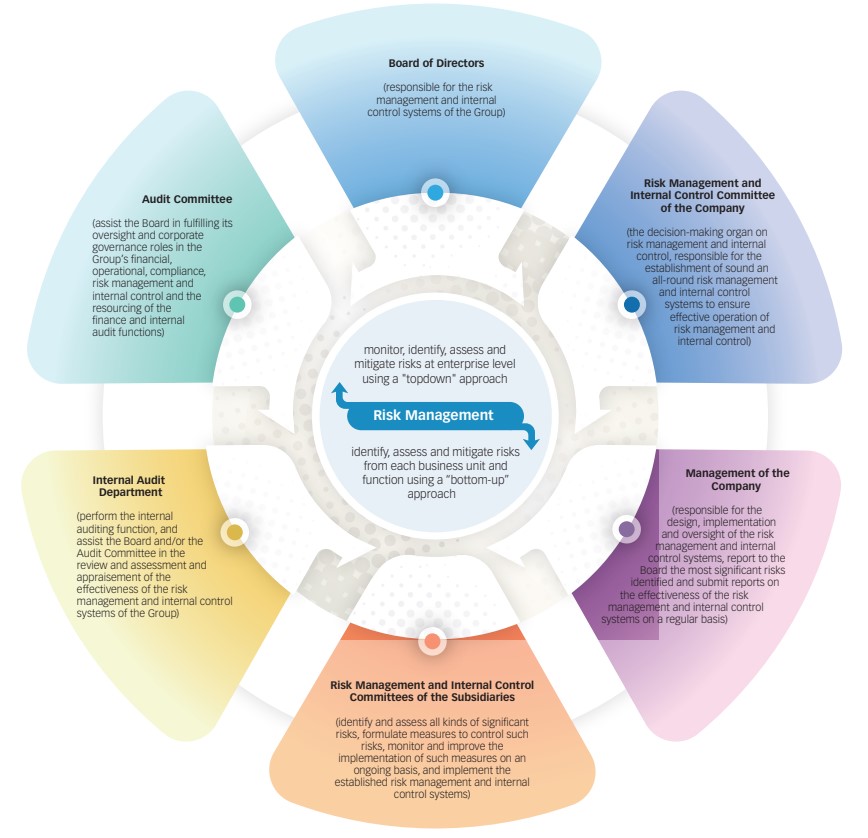
- the internal audit department of the Company (the “Internal Audit Department”) has an internal audit function, and shall assist the Board and/or the Audit Committee in the review of the effectiveness of the Group’s internal control and risk management systems (including environmental, social and governance risks) on an ongoing basis. The head of the Internal Audit Department shall report directly to the Audit Committee;
- the Company has also established the Risk Management and Internal Control Committee (the “Risk Control Committee”) comprising Mr. Zhou Jun, Mr. Hu Jun and heads of all departments, which shall determine the members of the committee and their respective responsibilities, define the work division among all departments and the duties and responsibilities of each group, and give instructions in relation to the commencement of risk assessment (including environmental, social and governance risks) and internal control assessment. The Risk Control Committee shall report directly to the Board about the significant risks that may affect the performance of the Group on a regular basis; and
- the Company will set up task group(s) in light of the actual situation, which will hold meetings regularly to review the effectiveness of the relevant financial, operational and compliance control as well as risk management procedures (including environmental, social and governance risks) and to review how to make further improvement.
The Company has implemented the following procedures to identify, assess and manage significant risks (including environmental, social and governance risks):
- the Company has formulated the Guideline on Risk Management (《風險管理工作指引》), and required the Company and all subsidiaries to manage risks in accordance with this guideline;
- the Company has established a whistleblowing policy, which is disclosed on the Company’s website and compendium of rules and regulations, to which employees, employees of subsidiaries and persons dealing with the Company may access, in order to enable them to raise concerns and report possible improprieties in any matter concerning the Company in a confidential and anonymous manner;
- all subsidiaries have set up their own risk management and internal control committees and identified their officer-in-charge for risk management. An annual inspection shall be carried out to identify their respective risks, assess all kinds of significant risks, formulate relevant control measures and continuously monitor and improve the risk management and internal control systems. Each of the risk management and internal control committees shall conduct an annual review in the middle of the year for self-inspection and self-reporting of risks/to check the implementation of such control measures, so as to ensure the feasibility and effectiveness of existing control measures;
- after collecting information on the risk profile of each subsidiary and the relevant control measures implemented by them, the Company would summarise a list of significant risks based on the major risk categories (including market risks, strategic risks, operation risks, financial risks, environmental, social and governance risks, etc.). After ranking these significant risks by priority, the management of the Company would identify the most significant risks and request the relevant companies to focus on the supervision of such risks;
- the Internal Audit Department would carry out the following tasks every year:
- to examine if all companies of the Group have focused their supervision on the most significant risks;
- to evaluate the report in relation to the most significant risks;
- to assess and ensure the effectiveness of the risk management procedures and the audit reporting process;
- to ensure accurate assessment of each risk; and
- to implement independent internal audits according to its internal audit plan.
- the Internal Audit Department would summarise and report the results of the work above to the Audit Committee on a yearly basis.
The formulation and execution procedures of the internal audit plan of the Company are as follows: the Internal Audit Department adopts a risk and control-based audit approach. An annual work plan will be formulated, covering the Group’s operations and businesses as well as all the major activities and processes of each subsidiary, and a special review will be carried out on the demand of the management. The audit result shall be submitted to the Audit Committee promptly for review. Where any deficiency in the internal control is identified, the subsidiaries are required to make improvements promptly according to the recommendations. Audit issues are tracked and followed up by the Internal Audit Department for proper implementation. The Internal Audit Department shall report to the Audit Committee on a regular basis, while the Audit Committee shall report the audit findings and/or progress of the audit work to the Board after reviewing the relevant information.
The Company adopted the Inside Information Management Policy (《內幕消息管理制度》) in 2013 (as revised in 2015), which provides guideline on the handling and dissemination of the Group’s inside information by the Directors and employees who may have access to such information as well as the relevant internal control measures. The Board has organised the establishment of the Inside Information Committee, a committee under the Executive Committee which comprises the executive Directors, the Company Secretary, the general manager of the capital operation department and the general manager of the legal department of the Company. The members of the Inside Information Committee shall take joint responsibility for the registration and management of the inside information and the insiders of the Group, which shall be organised and implemented by the Company Secretary and the capital operation department of the Company. The officer-in-charge of other departments, branch companies and subsidiaries of the Company as well as the invested companies over which the Company has significant influence shall be responsible for the confidentiality of such information arising within their management authority, and shall report and communicate such inside information that comes to their knowledge.
After being aware of any event potentially involving inside information, the senior officers of the relevant company shall fill in and submit the Inside Information Reporting Form (《內幕消息呈報表格》) truthfully on the date such inside information comes to their knowledge. Upon receipt of such alert, the Company Secretary shall promptly convey such inside information to the members of the Inside Information Committee for assessment. In accordance with the relevant provisions of the information disclosure rules, members of the Inside Information Committee shall assess the potential inside information, fill in the Inside Information Assessment Report (《內幕消息評估報告》) and decide whether a disclosure on such information is required. Where it is determined that a disclosure is required to be made, it shall be reported to the securities regulatory authority and made within three working days or as required by the regulatory rules and regulations.
In respect of the review of the adequacy and effectiveness of the risk management and internal control systems, the Internal Audit Department provides independent assurance regarding the adequacy and effectiveness of the Group’s risk management and internal control systems to the Board and the Audit Committee. The head of the Internal Audit Department shall report directly to the Audit Committee. With the assistance of the Internal Audit Department, the management of the Group shall be responsible for the design, implementation and monitoring of the risk management and internal control systems. The Annual Self-assessment Form of Internal Controls and Risk Management (《內部控制及風險管理年度自評表》) are dispatched to all subsidiaries, which shall be collected and consolidated by the Company. Such results shall be assessed by the Internal Audit Department and reported to the Audit Committee, which will then review such information and submit reports on the effectiveness of such systems to the Board on a regular basis. Where necessary, the task group(s) will hold meetings regularly to review the effectiveness of the relevant financial, operational as well as compliance control and risk management procedures and to make further improvements.
During the year, the Company has conducted the following major works relating to risk management and internal control:
- completed the relevant work of the 2025 risk management assessment and based on the 4 major risks identified from last year’s assessment, to further implement comprehensive risk management measures and ensure the relevant measures for those work associated with risk to be in place effectively. For the assessment of comprehensive risk management this year, there is no matter involving “One-vote Veto”. Meanwhile, safety management requirements and prevention measures were put in place in 2025, mainly through strengthening supervision and inspections; conducting business training and conducting specialised investigations, etc. There was no major safety duties incident took place in the Group throughout the year;
- in accordance with the Group’s strategic planning and the management’s annual management objectives, and taking into account the actual circumstances of business transformation of its subsidiaries, the Group diligently organised and implemented the internal audit work plan for 2025, and assisted its subsidiaries in enhancing their internal control and risk management capabilities;
- conducted reviews and audits in respect of matters relating to the Group’s compliance management, cost control and connected transactions;
- organised the staff of the Group to carry out specialised business training to improve risk management and internal control awareness and enhance the standard of the internal audit work, including arranging dedicated internal auditors to attend online and offline practical audit training, inviting professionals to conduct anti-corruption and bribery prevention educational trainings for the Group’s middle level management or above, and the executive positions members of its subsidiaries to enhance anti-corruption awareness; and
- during the year, the 2025 Audit Plan was fully completed, a total of 15 internal audit reports were issued. In respect of the 17 audit comments and recommendations provided for the financial year of 2025, improvement works on addressing audit-related issues were in progress, of which 15 were completed. All subsidiaries had been asked to make improvements according to such recommendations.
This year, the Board, through the Audit Committee, reviewed the risk management and internal control systems of the Group. The Board also reviewed and ensured the adequacy of the Group’s resources in accounting, internal audit and financial reporting functions, staff qualifications and experience as well as staff training courses. The Annual Self-assessment Form of Internal Controls and Risk Management (《內部控制及風險管理年度自評表》) had been dispatched to all subsidiaries, which had been collected and consolidated by the Company. Such results were assessed by the Internal Audit Department and reported to the Audit Committee, which then reviewed and reported the same to the Board. The Audit Committee and the Board were not aware of any areas of concern that would have a material impact on the financial position or operating results of the Group and considered the risk management and internal control systems to be generally adequate and effective.
On 27 May 2024, the Company established the Compliance Committee, a committee under the Executive Committee, responsible for resolving compliance issues of the Group. The terms of reference have been established as the basis for the committee’s duties. Since its establishment, the Compliance Committee actively performs its duties and exercises its authority by setting the strategic direction for the Group’s compliance management and establishing adherence to regulations, revising the CKS Compliance Policy (《珠江船務合規方針》) and the CKS Compliance Management Policy (《珠江船務合規管理辦法》) etc. in 2024. Meanwhile, the Company obtained compliance management system certifications on ISO 37301:2021 International Standard and GB/T 35770-2022 National Standard in October 2024.
REMUNERATION OF AUDITOR
The Company has engaged KPMG as its independent auditor for the year ended 31 December 2025.
For the year ended 31 December 2025, the Company paid the auditor of the Company the following fees for audit and non-audit services.
| 2025 HK$’000 |
2024 HK$’000 |
|
| Audit Services | 2,871 | 2,805 |
| Non-audit Services, including review of the interim report continuing connected transactions, annual results announcement, tax consulting and tax compliance services |
609 481 |
591 457 |
| 3,961 | 3,853 |
DIVIDEND POLICY AND DIVIDEND DECISION
The Board approved and adopted the Dividend Policy on 1 January 2019 with the objective of sharing the Company’s achievements with Shareholders. In determining the dividend distribution for future years, the Board will take into account the Company’s future capital budget planning and assess funding requirements for the coming years, and will consider comprehensively, among others, the profitability and financial position of the Group, before proposing dividend distributions for approval by Shareholders at the general meeting. Notwithstanding the foregoing, the target dividend to be distributed to Shareholders for each financial year shall not be less than 30% of the profit attributable to equity holders of the Company for that financial year (if any), and dividends may be paid entirely in cash or in non-cash form, or partly in cash and partly in non-cash form, subject to: (a) the Companies Ordinance (Chapter 622 of the Laws of Hong Kong); (b) the Listing Rules; and (c) the Articles of Association. The Board may revise the target dividend payout ratio having regard to the overall operating conditions of the Group.
The Board confirmed that the dividend decisions for the year were made in accordance with the Dividend Policy established by the Company.
COMMUNICATION WITH SHAREHOLDERS
The Board has established a shareholders’ communication policy and the procedures for Shareholders to nominate a candidate for election as a Director. The policy and procedure are available on the website www.cksd.com of the Company.
Set out below are procedures for Shareholders to (1) convene a general meeting; (2) put forward proposals at a general meeting; and (3) put enquiries to the Board. These procedures are generally governed by the Articles of Association and applicable laws, rules and regulations, which prevail over the below information in case of any inconsistencies.
1. Procedures for Shareholders to convene a general meeting
Pursuant to the Articles of Association and the Companies Ordinance of Hong Kong, registered Shareholders holding not less than one-twentieth (5%) of the paid up capital of the Company (the “General Meeting Requisitionists”) can deposit a written request to convene a general meeting at the registered office of the Company (the “Registered Office”), which is presently situated at 22nd Floor, Chu Kong Shipping Tower, 143 Connaught Road Central, Hong Kong for the attention of the Company Secretary.
The General Meeting Requisitionists must state in their request(s) the objects of the general meeting and such request(s) must be signed by all the General Meeting Requisitionists and may consist of several documents in like form, each signed by one or more of the General Meeting Requisitionists.
The Company’s share registrars (the “Share Registrars”) will verify the General Meeting Requisitionists’ particulars in the General Meeting Requisitionists’ request. Promptly after confirmation from the Share Registrars that the General Meeting Requisitionists’ request is in order, the Company Secretary will arrange with the Board to convene a general meeting by serving sufficient notice to all the registered Shareholders in accordance with all the relevant statutory and regulatory requirements. On the contrary, if the General Meeting Requisitionists’ request is verified to be not in order, the General Meeting Requisitionists will be advised of the outcome and accordingly, a general meeting will not be convened as requested.
The General Meeting Requisitionists, or any of them representing more than one-half of the total voting rights of all of them, may themselves convene a general meeting if the Board had not arranged to duly convene a general meeting within 28 days upon serving a written notice in relation to the general meeting within 21 days of the deposit of the General Meeting Requisitionists’ request, provided that any general meeting so convened is held within three months from the date of the original General Meeting Requisitionists’ request. Any reasonable expenses incurred by the General Meeting Requisitionists by reason of the Board’s failure to duly convene a general meeting shall be repaid to the General Meeting Requisitionists by the Company.
2. Procedures for Shareholders to put forward proposals at a general meeting
Shareholders may suggest proposals relating to the Company to be discussed at a general meeting by sending written requisition to the Board or the Company Secretary and following the procedures set out in the paragraph headed “Procedures for Shareholders to convene a general meeting” above to convene a general meeting for any business specified in such written requisition.
3. Enquiries to the Board
Shareholders may at any time send their enquiries and concerns to the Board in writing through the Company Secretary whose contact details are as follows:
| Address: | 24th Floor, Chu Kong Shipping Tower, 143 Connaught Road Central, Hong Kong |
| Telephone: | (852) 2859 1415 |
| Facsimile: | (852) 2186 7204 |
| E-mail: | maggie-cksd@cks.com.hk |
The general meeting is an important occasion for direct dialogues between Directors, senior executives and Shareholders, and the Company attaches great importance to any general meeting. All Directors (including independent non-executive Directors) and senior executives will try to attend the meetings, listen to Shareholders’ proposals in person, and answer questions raised by shareholders concerning the development strategies and operations of the Company. The Company welcomes Shareholders to attend general meetings in person, express their opinions and raise their enquiries to the Directors and management.
INVESTOR RELATIONS AND COMMUNICATIONS
The Company regards investor relations as utmost importance and discloses relevant information timely under the guidelines of the Listing Rules. Updates of the Company are communicated to institutional investors and analysts regularly. In the year, the Company frequently met with fund managers and investment bank analysts and responded swiftly to the queries of the small and medium investors.
The Board has reviewed the Company’s communications activities with Shareholders and investors for the year ended 31 December 2025, as well as the implementation of the measures mentioned above, and is satisfied that the Shareholder and investor communications policy is effective.
There were no amendments to the Articles of Association of the Company during 2025.